02 03 04 05 06 07 08 09 10 11 12 13 14 15 16
Showing posts with label Card Games. Show all posts

Oct 1, 2014

Analysis of Sushi Go!

Collect sushi with cute anime faces. Dip them in wasabi and triple their points!

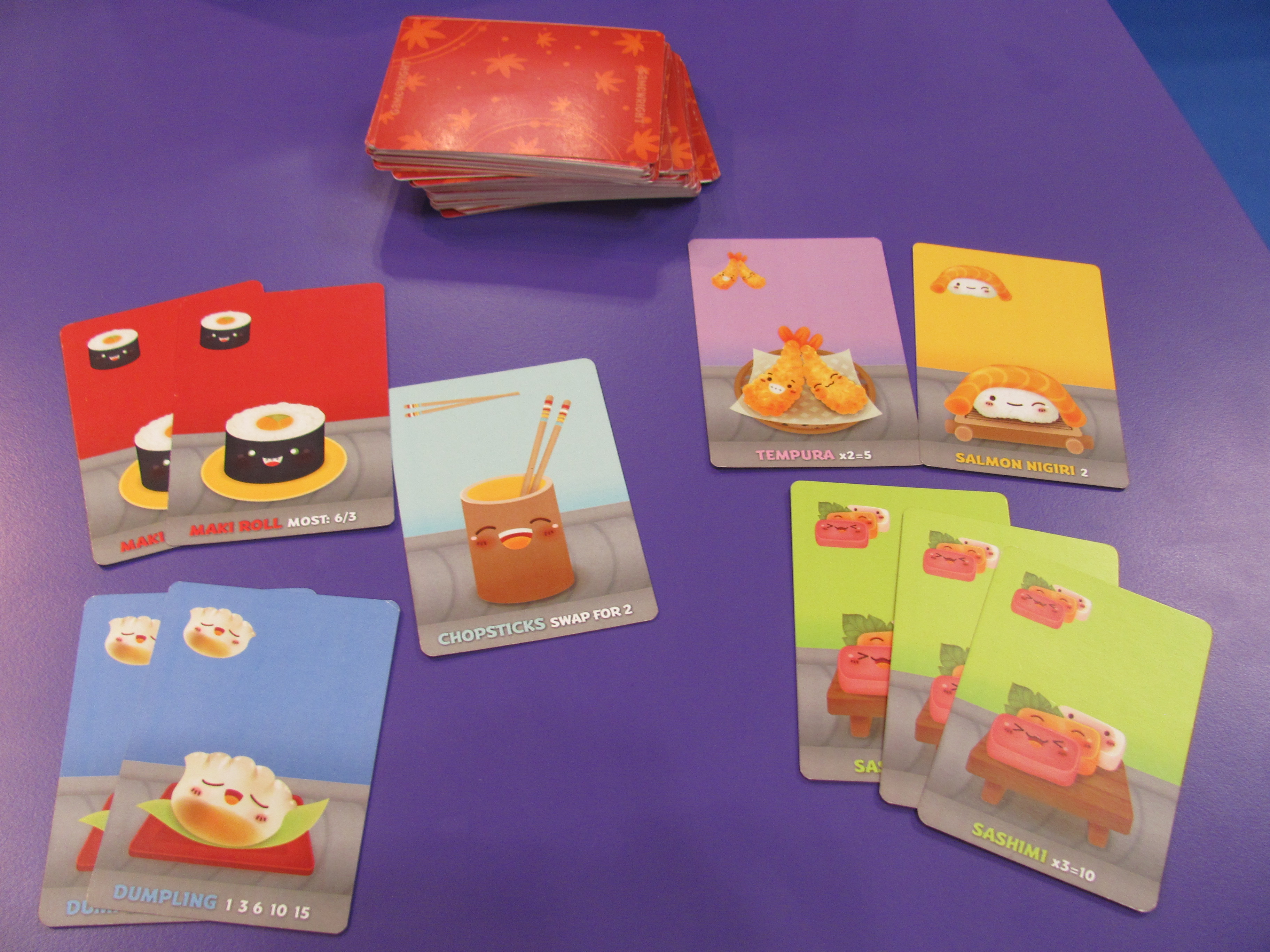
Every round in Sushi Go! you collect sushi of different kinds, then you count points based on what you picked. Often you need a collection of the same dish to get the required points, but some cards combos with another card.


Every round, each player starts out with X cards in their hand. Based on the number of players in the game, this is around 7-10 cards. Then each player picks one card and lays it face down on the table. At the same time all the players reveal their chosen card and then pass their hand to the player on the left. When all cards are gone, you count points based on the types of cards you picked. 3 Rounds and then you count the point total and the player with most points win.

I'm not gonna list all the cards and their effects. The game is really simple and should be picked up if you like cute games with lots of fun.

Analysis

The aesthetics of Sushi Go! are:

  • Fellowship: Competition
  • Challenge: Planning, Social Understanding


The competition is the wish to win over other players, which is exactly what the game is about. This is also evident since everyone has the same opportunity to pick the cards in the pool, making the choices you face every turn based on when the opponents are picking.

Planning comes in when you open the first hand. You see what your options are and must choose carefully. If someone is taking the same thing as you are, the chances that you are getting those pieces are diminishing. And for every card reveal, the planning must be altered which keeps the game fresh and interesting.

The social understanding comes from what I wrote above. You must not only think about what you want to take, but also what others want to take. You could alter your own strategy to pick the pieces no one's taking. Or you could pick the pieces others want before they get them to disturb their planning.

Core Loop

Pick card -> Get points

This is what you do all game. The theme of the game helps immensely when taking on this mechanic. Picking cards feel good because they are so cute. It's helps the player relax when thinking about what cards to pick. It also helps that many of the cards are flavored in such a way to make the understanding of the game easier. Dipping nigiri in wasabi gives triple points. Dumpling gives more points for each individual you pick. Getting the points is also satisfying since at the end of each round, you really feel content with what you got. Since every player at least finds some pieces which made him/her happy.

Mechanics and Dynamics

Mechanics:

  • Hands are passed around
  • Players pick cards
  • Players reveal their picked cards
  • Cards gives points based on other cards (combo based)


Dynamics:

  • Players wanting to pick certain cards which they think will works well together in the future (Comptetition, Planning, Social Understanding)
  • Players picking cards based on what the other players are building (Competition, Social Understanding)


Takeaway
The best thing Sushi Go! does is how good it's core loop is. Picking cards is easy and feels good to do. The faces add a nice atmosphere to the game which also helps players understand the rules to the game. Since sushi have become widespread in the western world, even kids will have an easy time figuring out how the mechanics are represented through the theme.

tl;dr a good theme makes mechanics easy and the game fun to play.

Sep 17, 2014

Analysis of Klondike - From computer to reality

How to use mechanics in a way the player can remembers, use and enjoy.

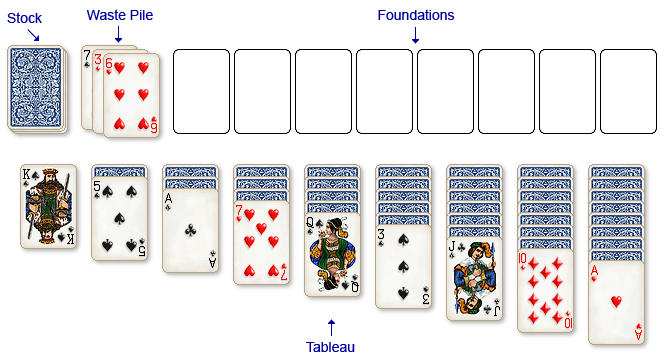
I'm gonna use the same picture this time around too because I like it and it is an accurate depiction on how a game of Klondike looks when played on a computer.
And this is how Klondike looks on my kitchen table. Both these games have the same mechanics, dynamics and aesthetics. The big difference between these two is that one of them is set up and handled by a machine and the other a human. Yes they are both played by humans, but in the tabletop version the player must take care of the setting up, the stock, revealing cards, checking wrong moves etc.

Simple system mechanics make human happy.
Klondike is designed to be played on a table with a human running through the motions. This can be noticed by how the game is set up and how the stockpile functions. The setup is easy to remember because it follows a easy motion:
Shuffle, One card up, count six more piles face down. One card up, one face down on the rest, One card up, one face down on the rest, repeat until there is a face up card on every pile. It feels good to deal out the cards and the stockpile is left in your hand afterwards. Simple and clean

The stockpile is also handled in a simple way. The player takes the three card on the top of the stockpile and lays them out. The topmost card can be moved which, if moved, the card below it can also be moved. If the player wants three new cards then the old ones are discarded face up to the waste pile which is kept in order and never shuffled. If all three cards are used up, the player can start using the topmost card in the waste pile.

Here comes a big rant though. While the mechanic feels good to use in the beginning, it stops feeling good once you realize that the cards in there gives you important information from the beginning. It now becomes a chore to look through the cards and memorizing them. For a player playing on a table it is much easier to just pick up the cards and look through them. For the computer it also behaves in a weird way which you probably won't bother to look up because you just want to submit to the rules. The sad part is also that this mechanic is crucial to winning the game, and when the player finds that out, submission lowers and challenge rises. Now you have to really think about your moves so that you can find the optimal way out at all times. 

Takeaway
When designing card games, especially ones you play with paper, you need to consider simple mechanics which is easy to remember and still feels enjoyable to use while containing a good gameplay.

The setup is a good example of a simple system of actions the player performs to get the game going. The stockpile, while feeling natural to use, fails when the player realize it's importance to finishing the game, which then cannot be ignored when playing in the future.

The stockpile creates the conflict between Submission and Challenge which splits the player in two sides based on how much they know/experienced of the game. It creates a nice front, but it's a game that will ultimately fall flat on its belly for anyone playing it long enough to actually want to learn the tricks of the game.

Sep 15, 2014

Analysis of Klondike - Effective submission game design

You probably have this game on your computer. It's an all time classic to play when bored and it can be a really addicting pastime. The colors of the cards is the most important lesson!


Klondike is a form of solitaire which means single player card games. I think most people would recognize this game through their computer since it's one of windows most classic "games which comes with the machine". I also think almost everyone has played it at least once, and the design of this game makes it easy to pick up at all times. Here is a link to the rules, let's begin cutting it open!

Core Loop
The core loop of Klondike consists of
Move card(s) --> Reveal card

Mechanics
Moving a card is clicking a card which lies on top of either the tableau, waste pile or foundation and then dragging that card to another card on the tableau which is one number higher and in a different color.

You can move to another card on the foundation with a number which is one lower and in the same suit. Aces can be moved to empty spaces in the foundation.

Revealing a card is done when there is only face down cards in one column on the tableau in which case you flip the topmost card face-up.

The players action is moving of the cards. The reward for moving cards correctly is the revealing of the card beneath. Some cards are allowed to be collected based on previous cards collected. This is the core loop of the game which repeats itself.

The first thing of interest is the how the colors of the cards interact with each other. Since the player always needs to look at what cards they need to move right now, the color of the cards not only makes them easier to search for, but it also shapes an appealing pattern when laying them on top of other cards. Humans love seeing patterns everywhere, and this core loops abuses it.

The revealing of the cards is also interesting. It comes as a reward which feels nice for the player, but it also creates a sense of suspense to find out what new possibilities comes for future needs. Maybe you've been waiting for an 8 to come along for some time now. You will wish for that 8 for every card you reveal, hoping it will give you the miracle you need.

Aesthetics
Challenge: Logic puzzle(Brain teaser?)
Submission: Rules indulgence

As a single player card games with non-narrative cards, submission and challenge is what Klondike is achieving. There are rules which you follow strictly(Submission) and the game is really challenging to complete(Challenge). It's the type of game where the rules are simple while figuring out how to use them well is a bit complex which creates the challenge of wanting to understand the system. Since the game isn't hard to play and can be fun to sit through even without thinking too hard about it I would say challenge is a minor Aesthetic. The rules are everything in this game, and the player only moves according to the rules. Which means we can turn our brains off the let ourselves indulge in the game world.

Takeaways
I'll be doing this also. Because if you are just analyzing, then you're missing the point of analyzing. We're doing this to improve, so what can we learn from Klondike?

The game's Aesthetic wants us to relax and sit back and it does it through it's really good set of rules and especially in the number/color matching which creates patterns every human loves. The takeaway here is that pattern matching makes really good submission games(Oh right candy crush saga makes so much sense now...).

Sep 14, 2014

A deck of cards and unlimited potential

The plan is to get a habit of doing something creative. Let's take a look at the many games that uses playing cards!

"Read everything. Cut them open. Steal their power." -Warren Ellis
Those are words from a comic author about improving your craft. for game designers, this could easily translate into play games ehu! But that doesn't cut it alone, because that's not giving you anything back. The analytic part is what creates improvement, and this is where my new plan comes in.

I bought a deck of cards.
Adam recommends getting a habit of doing something creative at least once a day, to get in the routine. I've always been interested in card games, especially how cards can translate into simple and clean mechanics. So, I'll be looking at card games that uses one deck of regular playing cards. 52 cards and three jokers, what possibilities does it hold? It is time to look at, test and analyse different card games and to find out what makes them tick.

Lots of different games.
There are maaaaany different card games out there. And many of them are really complicated and rules heavy. My initial research (Googling card games) showed me that there are a lot of point grabbing games, often where the main goal is to get pairs of different kinds and then writing down points based on performance. Already, these aren't the games I prefer, but I'll at least take a look at some of them since they are classics. What I'm more interested in is card games with interesting rules and win condition. President and Old Maid is the kinds of game that interest me the most, since they go beyond the simple get points system.

Where do we go from here.
Looking at card games, analyse them and then of course build one myself! That is the goal of this exercise and I hope to learn something that will aid me in my studies.

It's always good to overachieve!